Exploring socioeconomic and clinical predictors of diabetic foot ulcer healing: A post-hoc analysis
Received:
Accepted:
Published:
Authors: Windy Cole, Nina Kovalyn, Jacob Wielgomas, Jacqueline Donovan, Romeo Vences-Leonard
Corresponding author:
Windy Cole, Director of Wound Care Research, College of Podiatric Medicine, Kent State University, OH, USA, Email: wcole4@kent.edu
DOI
10.63896/gwcj.2.2.28
Background: Diabetic foot ulcers (DFUs) affect up to 25% of individuals with diabetes and remain a leading cause of non-traumatic lower limb amputation. While clinical severity is a well-established predictor of healing, the role of socioeconomic disadvantage in short-term outcomes is less clear. This study explores the combined influence of clinical and neighbourhood-level socioeconomic factors on DFU healing.
Methods: We conducted a post-hoc analysis of 40 patients enrolled in a randomised clinical trial at an inner-city wound care clinic. The primary outcome was ulcer healing (healed versus not healed). Explanatory variables included Wagner Grade, Area Deprivation Index (ADI), age, gender and race. ADI scores were derived from participants’ ZIP codes using validated census-based indicators. Statistical analyses included correlation, Wilcoxon rank sum tests, logistic regression, and generalised additive models, with significance set at p < 0.05.
Results: Overall, 65% of ulcers healed, with a median healing time of 10 weeks (IQR: 5–24). Wagner Grade was the strongest predictor of healing (β = -2.767; p = 0.0057), with higher grades associated with lower healing rates. ADI showed a non-significant trend toward poorer healing (r = 0.216; p = 0.1366). Hispanic ethnicity demonstrated marginal significance (β = -1.961; p = 0.0567). No significant associations were observed for age, gender, or other racial categories.
Conclusions: Clinical severity, as measured by Wagner Grade, remains the dominant determinant of DFU healing, while socioeconomic disadvantage, captured by ADI, did not independently predict short-term outcomes in this cohort. These findings underscore the importance of early detection and aggressive management of DFUs, while highlighting the need for larger, multi-site studies incorporating granular socioeconomic data. Integrating clinical and social risk factors into predictive models may enable more equitable, targeted interventions to improve outcomes for vulnerable populations.
Diabetic foot ulcers (DFUs) affect up to one in four individuals with diabetes during their lifetime, making them a leading cause of non-traumatic lower limb amputation and a major driver of healthcare costs worldwide (Caruso et al, 2020). Healing outcomes are shaped not only by clinical severity but also by social determinants of health, which introduce significant disparities across racial, ethnic, and socioeconomic groups (Nather et al, 2010). Although these disparities have been documented, the complex interplay between clinical and socioeconomic factors remains insufficiently understood.
Socioeconomic disadvantage is increasingly recognised as a critical determinant of DFU outcomes. The Area Deprivation Index (ADI), a composite measure of neighbourhood-level socioeconomic status, integrates indicators such as income, education, employment, and housing quality (Kind and Buckingham, 2018). Higher ADI scores reflect greater deprivation and have been linked to poorer health outcomes, including delayed wound healing (Kind and Buckingham, 2018). Understanding the role of ADI in DFU healing could enable clinicians to identify high-risk patients and design targeted interventions to reduce inequities.
Clinically, the Wagner classification system has long been used to predict DFU healing potential based on ulcer severity (Wang et al, 2022). However, the relationship between socioeconomic disadvantage, captured by ADI, and wound healing among patients enrolled in randomised controlled trials (RCTs) has not been widely explored. Leveraging prospectively collected data from our DFU trial registry, this study examines whether ADI and Wagner classification independently predict healing outcomes.
Based on prior evidence associating socioeconomic disadvantage with worse health outcomes, we hypothesised that both ADI and Wagner classification would be significant predictors of DFU healing. Our objective is to evaluate the combined influence of neighbourhood-level deprivation and clinical severity on wound healing in an inner-city population, with the goal of informing strategies to mitigate disparities in diabetic foot care.
Methods
A post-hoc analysis was conducted using data from a total of 40 patients that we enrolled at our facility as part of a multicentre randomised controlled trial treating DFUs at an inner-city clinic. A retrospective review of a prospectively maintained database of case report form data was performed. Table 1 summarises the demographic and clinical characteristics. Do these ethnicities map to the local population served by your service, or is diabetes higher in certain ethnicities?
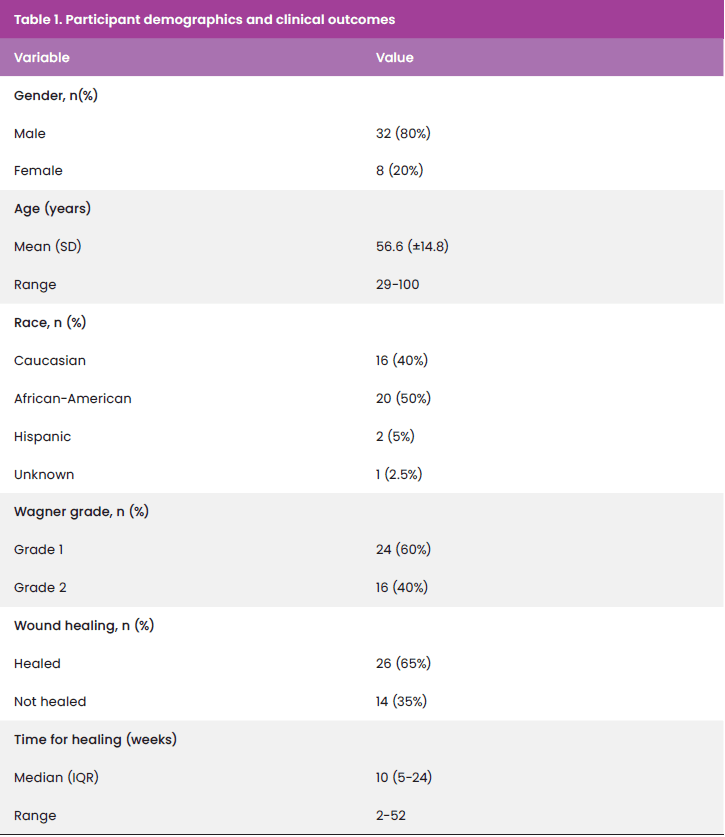
Area Deprivation Index scores were calculated using participants’ 9-digit ZIP codes, linked to publicly available census data.
The ADI is calculated using 17 socioeconomic indicators derived from US Census data. These indicators are grouped into four domains:
- Income: Median family income, per cent of families below poverty level, per cent of households receiving public assistance.
- Education: Per cent of adults without a high school diploma.
- Employment: Unemployment rate, per cent of employed persons in low-skill occupations.
- Housing: Per cent of households without a vehicle, per cent of households without telephone service, per cent of occupied housing units without complete plumbing, and per cent of renter-occupied housing units.
Each variable is standardised (z-scores), weighted, and combined into a composite score. The final ADI score is then ranked nationally or within a state on a scale from 0 (least deprived) to 100 (most deprived). This index captures multiple dimensions of deprivation, including income, education, employment, and housing characteristics, and has been validated as a predictor of health disparities. In this study, ADI was treated as a continuous variable and examined for its association with DFU healing outcomes.
The primary outcome was ulcer healing (binary: healed vs. not healed). Explanatory variables included ADI, age, gender, race, and Wagner Grade. Statistical analyses comprised point biserial correlation, Wilcoxon rank sum tests, binary logistic regression, and generalised additive models. Significance was set at p < 0.05.
Results
- Correlation Analysis: ADI demonstrated a weak positive correlation with healing (r = 0.216; p = 0.1366).
- Regression Analysis: Wagner Grade was a significant predictor of healing (β = -2.767; p = 0.0057), indicating that higher grades were associated with lower healing rates.
- Generalised Additive Model Findings: Wagner Grade remained significant (β = -3.233; p = 0.0024). Hispanic race showed marginal significance (β = -1.961; p = 0.0567).
Additional Insight: Wagner Grade correlated negatively with healing (r = -0.340), reinforcing its clinical importance [Figure 1].
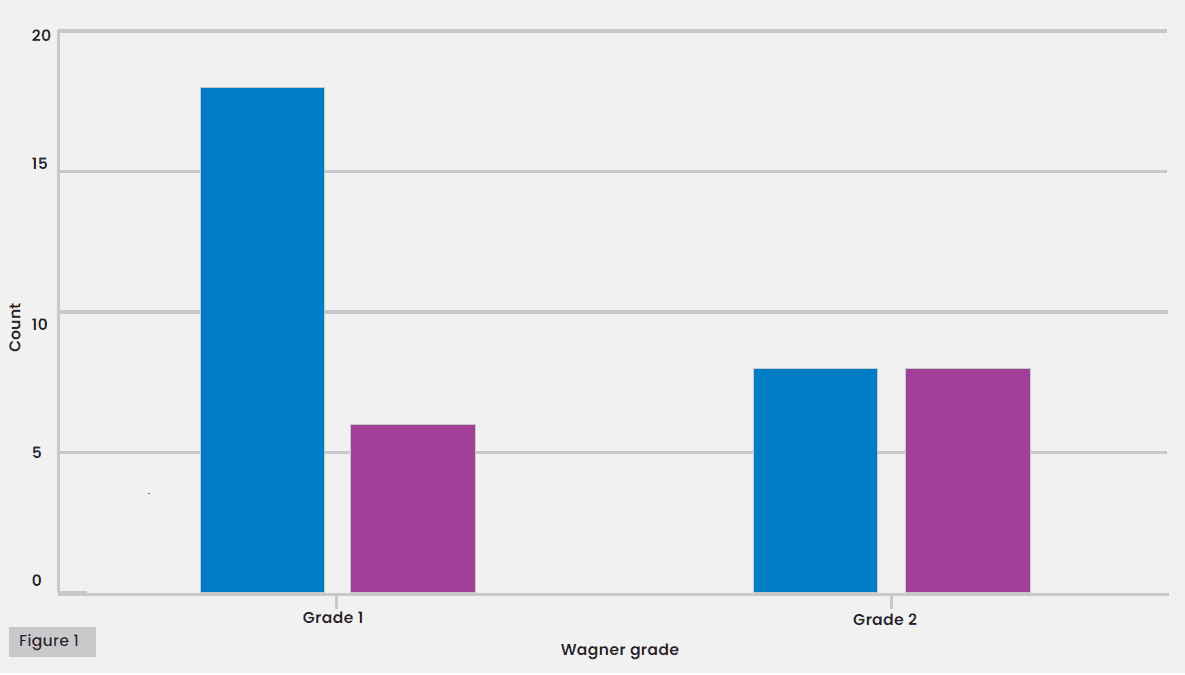
Figure 1. Healing correlation by Wagner grade
Discussion
This post-hoc analysis provides important insights into the relative influence of clinical and socioeconomic factors on DFU healing. Our findings underscore that clinical severity, as measured by Wagner Grade, remains the most significant predictor of healing, consistent with prior evidence that ulcer depth and complexity strongly dictate outcomes (Gul et al, 2006). The negative association between higher Wagner grades and healing probability reinforces the need for early detection and aggressive management of DFUs before progression to advanced stages.
Although the ADI demonstrated a non-significant trend toward poorer healing, its lack of statistical significance in this cohort warrants careful interpretation. Several factors may explain this observation. First, the relatively small sample size (n = 40) limits statistical power to detect modest effects of socioeconomic disadvantage. Second, the use of ZIP code-based ADI scores may obscure individual-level socioeconomic variability, potentially diluting its predictive capacity. These limitations highlight the complexity of operationalising social determinants of health in clinical research and suggest that granular, patient-level socioeconomic data may be necessary to fully capture their impact on DFU outcomes.
The marginal association observed with Hispanic ethnicity, while underpowered, raises important questions about cultural and systemic influences on wound care. Prior studies have documented disparities in access to podiatric services, adherence to offloading protocols, and health literacy among minority populations. Future research should explore whether these factors mediate healing outcomes and how culturally tailored interventions might mitigate inequities.
Our results align with emerging literature emphasising that clinical severity often overshadows socioeconomic disadvantage in short-term healing trajectories, yet social determinants may exert stronger influence on long-term outcomes, such as recurrence, infection and amputation risk (McDermott et al, 2023; Ojo et al, 2025; Hu et al, 2018). Integrating ADI or similar indices into risk stratification models could still be valuable for identifying patients who may face barriers to care, even if these measures do not independently predict initial healing.
From a clinical perspective, these findings reinforce the primacy of early intervention and severity-based triage in DFU management. However, they also underscore the need for multidimensional care strategies that address both biological and social risk factors. For example, pairing advanced wound therapies with community-based support programs, transportation assistance, and culturally competent education may optimise outcomes for socioeconomically disadvantaged patients.
Limitations
Several limitations should be acknowledged. First, the modest sample size (n = 40) constrains statistical power and may obscure subtle associations between socioeconomic disadvantages and healing outcomes. Second, single-site design limits external validity, as care delivery models and patient demographics may differ across settings. Third, socioeconomic status was operationalised using ZIP code-level ADI scores, which, while validated, cannot fully capture individual-level variability or household-specific barriers to care. Fourth, the post-hoc nature of this analysis precludes causal inference and introduces potential residual confounding from unmeasured factors such as comorbidities, adherence to offloading, and access to advanced therapies. Finally, racial and ethnic subgroup analyses were underpowered, and observed trends should be interpreted as hypothesis-generating rather than definitive.
Conclusion
This study reinforces the dominant role of clinical severity, specifically Wagner Grade, in predicting DFU healing, while socioeconomic disadvantage, as measured by ADI, showed only a non-significant trend. These findings suggest that ulcer complexity remains the primary determinant of short-term healing, yet social determinants may exert greater influence on long-term outcomes, such as recurrence and amputation risk. Future research should employ larger, multi-site cohorts and incorporate granular, patient-level socioeconomic data to clarify these relationships. Integrating clinical and social risk factors into predictive models could enable more equitable, targeted interventions, ultimately improving outcomes for vulnerable populations.