Letter to editor: Ouroboros theory of integumentary dysfunction
Received:
Accepted:
Published:
Authors: Heather Barnhart
Citation:
Barnhart H, (2026) Letter to editor: Ouroboros theory of integumentary dysfunction. Global Wound Care Journal 2 (1): 13.
DOI:
10.63896/gwcj.2.1.13
Dear Editor
The ouroboros – an ancient emblem of a serpent consuming its own tail – symbolises continuity, unity, and the cyclical interconnectedness of all things [Figure 1]. I propose this symbol as a conceptual model for understanding integumentary dysfunction. Rather than viewing wounds or skin breakdown as isolated events with singular aetiologies, the ouroboros metaphor illustrates how dermatological, vascular, lymphatic, metabolic and mechanical factors continually influence one another; an integrated symphony of biology, physiology, and anatomy. Leonardo da Vinci even stated “realise that everything connects to everything else”.
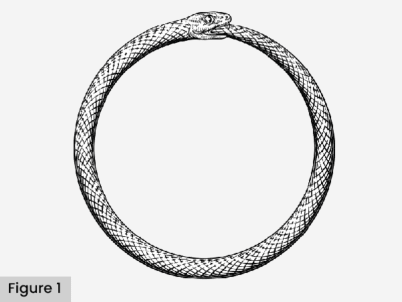
Figure 1. Ouroboros ring
Modern medical practice has advanced to a degree that necessitates subspecialisation, yet this progress has also inadvertently siloed our understanding of human physiology. We are trained to treat body systems as separate entities, often narrowing our clinical lens to a single discipline. As Carrie Sussman stated regarding wound care: “Look at the whole patient, not just the hole in the patient”. The ouroboros framework reinforces this principle by emphasising that disruption in one system inevitably influences others.
A wound, regardless of the assigned aetiology, represents integumentary dysfunction: a breach in the body’s protective armour. While labelling ulcers as venous, arterial, diabetic or otherwise can help guide clinical management, these categories often oversimplify the complex interplay of comorbidities and pathophysiological processes involved.
For example, in venous leg ulcers (VLUs), chronic venous insufficiency (CVI) is typically identified as the primary cause. However, applying an interconnected model reveals that VLUs develop from a constellation of processes: venous valve failure, inadequate muscle pump function, lymphatic overload, endothelial inflammation, glycocalyx disruption, lymphatic hypertension and subsequent fibrosclerosis. When lymphatic transport capacity is exceeded, low-protein oedema forms; over time, persistent lymphatic hypertension leads to lymphangitis, lymphostatic dermopathy and, ultimately, phlebolymphedema – particularly common in patients with obesity and adipokine dysregulation.
Simultaneously, endothelial mechanical stress promotes nitric oxide production, release of vasoactive mediators and extravasation of red blood cells, resulting in fibrin and haemosiderin deposition – hallmarks of chronic venous disease. These events further heighten lymphatic load, illustrating how CVI and lymphatic dysfunction are mutually reinforcing.
Beyond VLUs, additional frameworks, such as lymphosomes, angiosomes, dermatomes, biotensegrity and glycosylation biology, underscore the extensive interdependence among the circulatory, lymphatic, nervous, metabolic, and integumentary systems. For instance, aberrant glycosylation affects endothelial permeability, podoplanin function, immune modulation, and lymphatic vessel integrity, contributing to the progression of inflammatory, infectious and neoplastic diseases.
Taken together, these processes form an ouroboric cycle of dysfunction in which each system continuously influences the others. Recognising this interconnectedness may encourage clinicians to adopt a more holistic, systems-based approach to assessing and treating integumentary pathology.
Thank you for considering this perspective. I hope the ouroboros model stimulates further discussion on integrative frameworks for understanding and managing complex wounds and skin disorders.