The efficacy, safety and patient satisfaction of platelet-rich plasma and fluid platelet-rich fibrin in chronic wound healing (2017–2025): A systematic review
Received:
Accepted:
Published:
Authors: Zohreh Khodashenas, Hanieh Pourkalhor
Citation:
Khodashenas Z and Pourkalhor H, (2026) The efficacy, safety and patient satisfaction of platelet-rich plasma and fluid platelet-rich fibrin in chronic wound healing (2017–2025): A systematic review. Global Wound Care Journal 2 (2): 32-37.
Corresponding author:
Zohreh Khodashenas, Department of Dermatology, Faculty of Medicine, Shahed University, Tehran, Iran, Email: z.khodashenas@shahed.ac.ir
DOI
10.63896/gwcj.2.2.32
Background: Chronic wounds pose significant clinical challenges due to delayed healing and high complication rates. Platelet-rich plasma (PRP) and fluid platelet-rich fibrin (PRF) are autologous regenerative therapies that release growth factors to promote healing, yet evidence remains heterogeneous.
Aim: This systematic review evaluates the efficacy, safety and patient-reported outcomes of PRF and PRP in chronic wound healing.
Methods: A systematic search was conducted in PubMed, Scopus, Web of Science, Embase and Cochrane Library (January 2017–March 30, 2025) following PRISMA 2020 guidelines. Eligible studies were randomised controlled trials (RCTs) and clinical trials on PRP/fluid PRF in chronic wounds. Two reviewers independently screened studies, extracted data and assessed risk of bias using Cochrane tools. No meta-analysis was performed due to high heterogeneity.
Results: Twenty studies were included for qualitative synthesis. PRP and fluid PRF demonstrated improved wound closure rates, reduced healing time and low adverse events compared to conventional care in diabetic, pressure and surgical wounds. Fluid PRF showed advantages in granulation and angiogenesis, while PRP gel reduced infection and pain. Most studies had moderate risk of bias, mainly due to lack of blinding.
Conclusion: PRP and fluid PRF appear safe and effective as adjunct therapies for chronic wounds, particularly in refractory cases. Standardisation of preparation protocols and larger RCTs are needed to confirm long-term benefits.
Chronic wounds represent a significant global health challenge, affecting millions of patients and imposing a substantial financial and logistical burden on healthcare systems worldwide (Su et al, 2023). These wounds, including diabetic foot ulcers, pressure injuries, venous leg ulcers and postoperative wounds, are often difficult to heal and are associated with high rates of infection, amputation, reduced quality of life, and increased healthcare costs (Li et al, 2024; Hu et al, 2026). Despite advances in conventional wound care, complete healing remains elusive for many, highlighting the need for effective therapies (Dohan Ehrenfest et al, 2009; Suthar et al, 2017).
Traditional approaches such as debridement, negative-pressure wound therapy and advanced dressings often fail in complex cases (Prabhu et al, 2018; Li et al, 2020). Regenerative therapies, such as PRP and PRF, have emerged as promising adjuncts (Elsaid et al, 2020; Martínez-Zapata et al, 2016).
PRP is an autologous platelet concentrate enriched with growth factors — PDGF, VEGF, TGF-beta, EGF — promoting proliferation, angiogenesis and matrix remodeling (Hertel et al, 2021; Gohar et al, 2020; Capion et al, 2021). PRF forms a fibrin matrix for sustained release, offering prolonged effects (Helmy et al, 2021; Barwijuk et al, 2024).
One of the earliest randomised controlled trials demonstrated that autologous PRP gel improved healing outcomes in diabetic foot ulcers (Driver et al, 2006). More recent studies show improved closure and reduced infections, but inconsistencies persist due to variations in methods (Deng et al, 2022; Singampalli et al, 2022).
Prior reviews are limited by outdated evidence or insufficient focus on patient outcomes like pain (Li et al, 2023; Su et al, 2023). This review synthesises 2017–2026 evidence on PRP and fluid PRF’s efficacy, safety and satisfaction to guide clinical practice and research.
Methods
This systematic review adheresd to PRISMA 2020 guidelines.
The protocol was not prospectively registered in PROSPERO due to an oversight; however, transparency was ensured through strict adherence to PRISMA.
Eligibility criteria (PICO framework)
- Population: Adults with chronic wounds (e.g. diabetic ulcers, pressure injuries, venous leg ulcers, surgical wounds lasting >4 weeks).
- Intervention: PRP, fluid PRF or PRP gel, alone or combined with standard care.
- Comparison: Standard wound care, placebo or no intervention.
- Outcomes: Primary: Wound closure rate, healing time. Secondary: Safety (adverse events), patient satisfaction (e.g. pain scores, quality of life).
Inclusion and exclusion criteria
The inclusion criteria included: RCTs, clinical trials and meta-analyses published in English full-text from January 2017 to 30 March 2025. The exclusion criteria included: case reports, editorials and studies with unclear PRP/PRF protocols or irrelevant outcomes.
Information sources and search strategy
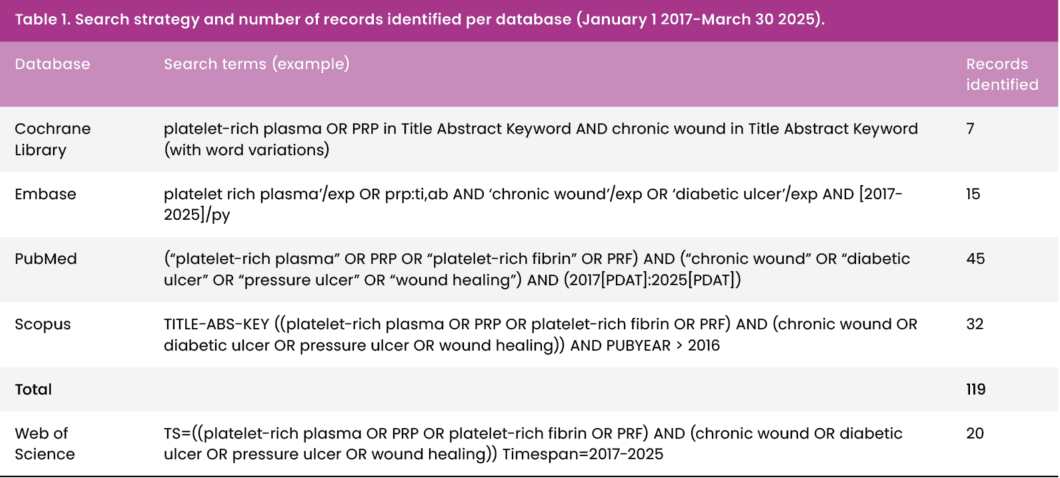
The following databases were searched: PubMed, Scopus, Web of Science, Cochrane Library and Embase.
Search terms included “platelet-rich plasma” OR “PRP” OR “platelet-rich fibrin” OR “PRF” AND “chronic wound” OR “diabetic ulcer” OR “pressure ulcer” OR “wound healing” [Table 1]. There were no filters for language beyond English.
Study selection
Two reviewers independently screened titles/abstracts and full texts. Disagreements were resolved by consensus. The PRISMA flow diagram is shown in Figure 1.
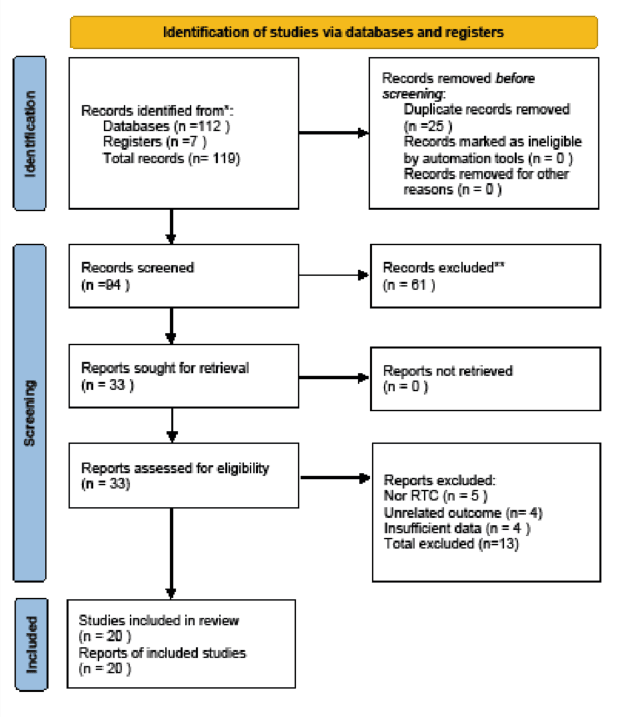
Figure 1. PRISMA 2020 flow diagram.
Data extraction
The reviewers used a standardised form for study characteristics, population/wound type, interventions/comparators, outcomes, adverse events and satisfaction.
Risk of bias assessment
RCTs were assessed via Cochrane Tool: + (low risk), ? (unclear) and - (high risk) for domains including random sequence, allocation concealment, blinding, incomplete data and selective reporting. This is summarised in Table 2.
Synthesis of results
A qualitative synthesis was employed due to clinical heterogeneity (e.g., wound types, PRP preparations); no meta-analysis performed.
Results
Twenty studies met inclusion criteria [Figure 1]. These included RCTs and trials on diabetic (n=12), pressure (n=5) and mixed chronic wounds (n=3), with sample sizes ranging from 20 to 200 patients.
Key findings from included studies from 2017–2018 consistently showed PRP and PRF benefits in wound closure, reduced healing time and safety in case series and observational designs (Suthar et al, 2017; Prabhu et al, 2018).
Several 2020 meta-analyses and RCTs reported PRP increasing healing rates and reducing healing time in diabetic and venous ulcers, with PRP gel shortening healing time and reducing pain/antibiotics use (Elsaid et al, 2020; Hosseini et al, 2020; Li et al, 2020; Martínez-Zapata et al, 2020).
The 2021 RCTs and prospective studies indicated L-PRP accelerating healing without infections, PRF reducing ulcer area and PRP improving ceasarean wound scores and pain (Helmy et al, 2021; Hertel et al, 2021; Mohamed et al, 2021).
The studies from 2022 demonstrated PRP improving tendon-exposed wounds, PRF reducing limb ulcers and faster healing in trauma ulcers (Singampalli et al, 2022; Zhang et al, 2022).
The 2023 meta-analyses showed that PRF improved oral resection healing and scars, PRP boosted rates and cut healing times, VSD+PRP shortening diabetic foot ulcer (DFU) healing times and autologous PRP being safe for DFUs (Huang et al, 2023; Li et al, 2023; Long et al, 2023; Napit et al, 2023; Su et al, 2023; Yin et al, 2023).
Meanwhile, the 2024 meta-analyses confirmed that PRP reduced the size of pressure ulcers and improved cures and time, while allogeneic PRP boosted rates and reduced hospital stays. L-PRF was found to accelerate DFU healing rates ( Li et al, 2024; Peng et al, 2024; Wang et al, 2024; Hu et al, 2026).
Most studies reported no major adverse events, with high patient satisfaction in terms of reduced pain and improved quality of life.
Discussion
Findings indicate PRP and fluid PRF enhance healing in diabetic, pressure, and surgical wounds (Su et al, 2023; Li et al, 2024; Hu et al, 2026). RCTs show accelerated closure, regeneration, and reduced infection versus standard care (Li et al, 2020). Heterogeneity in populations and protocols limits generalisability.
PRP injections promote deep tissue repair, while topical PRP gel acts as a protective barrier. The fluid fibrin matrix of PRP provides sustained growth factor release, superior for granulation and angiogenesis (Helmy et al, 2021; Singampalli et al, 2022). Patient satisfaction is high, with reduced pain scores noted in several trials (Hosseini et al, 2020; Mohamed et al, 2021).
Compared to earlier reviews, this synthesis incorporates recent 2024–2026 evidence, highlighting PRF’s advantages in the treatment of refractory ulcers (Wang et al, 2024; Hu et al, 2026).
Strengths include: comprehensive search up to 2025, inclusion of patient outcomes, qualitative approach avoiding pooling bias, adherence to PRISMA.
Limitations include: the study exposed high heterogeneity and moderate bias from lack of blinding. In addition, there were small samples in some studies and also, there was no quantitative meta-analysis.
Future research should standardise PRP/PRF preparation and larger RCTs should be conducted with long-term outcomes.
Conclusion
PRP and fluid PRF offer safe, effective options for chronic wound management, improving closure, reducing pain and enhancing patient satisfaction with treatment outcomes. Clinical adoption requires protocol standardisation.